Quality trimming
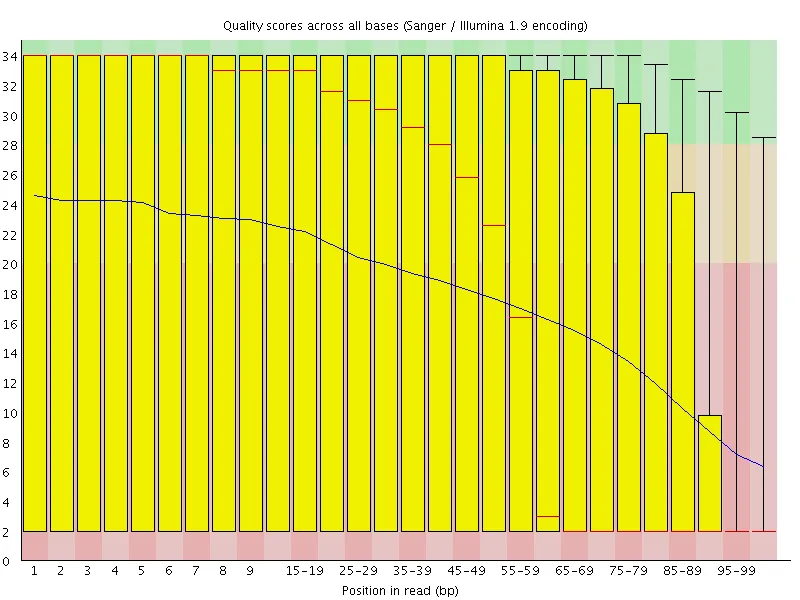
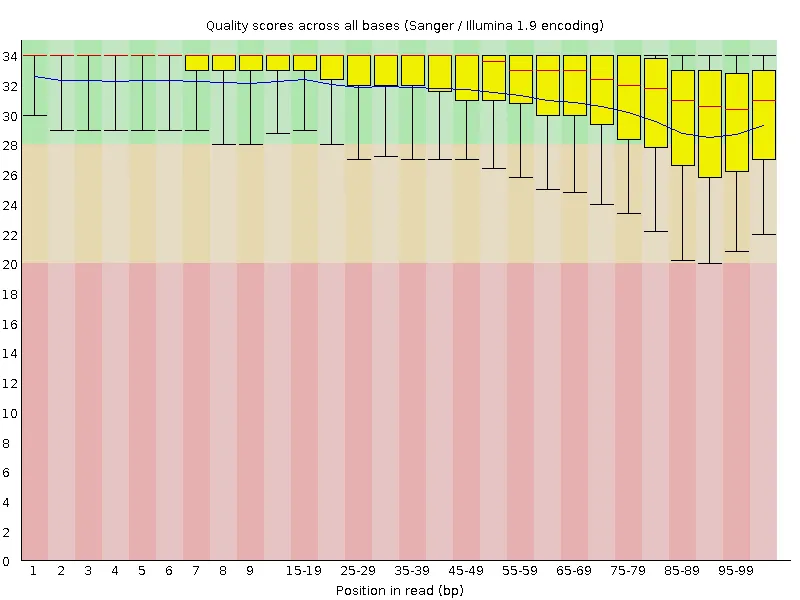
In the first step, low-quality base calls are trimmed off from the 3' end of the reads before adapter removal. This efficiently removes poor quality portions of the reads.
The default Phred-score cutoff is 20 (-q 20). Trimming uses the BWA algorithm: the running sum of (cutoff - Q) is computed from the 3' end, and bases are removed up to the position with the maximum cumulative score.
Example: before and after
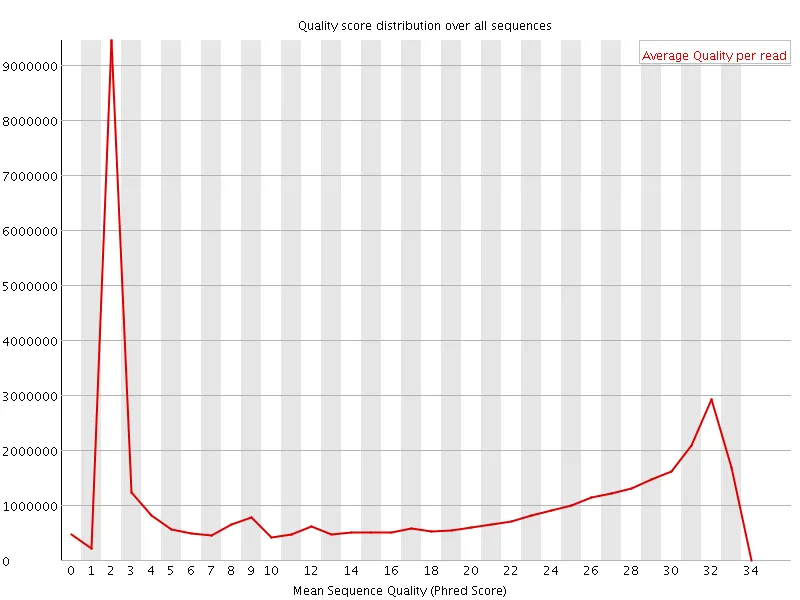
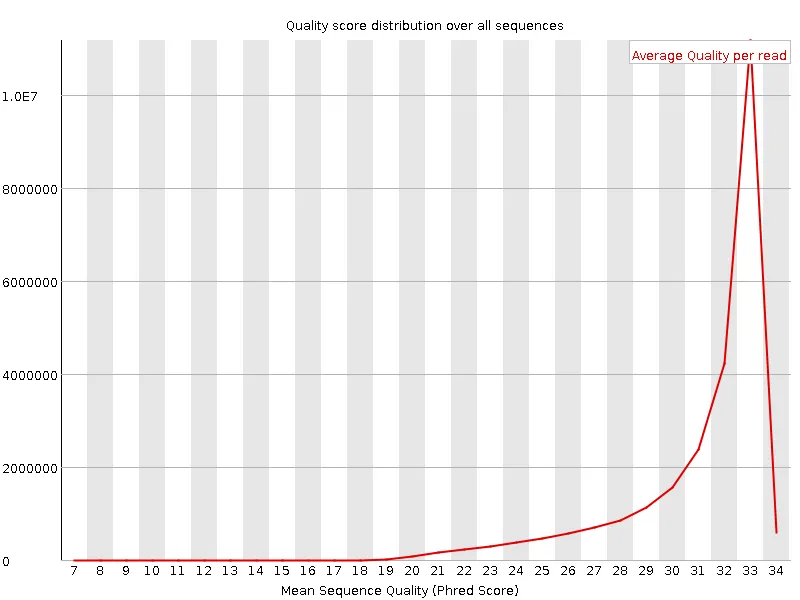
Section titled “Example: before and after”The plots below show a public dataset (DRR001650_1, Kobayashi et al., 2012) before and after trimming with -q 20.
| Before quality trimming | After quality trimming |
|---|---|
 |  |
 |  |
2-colour instrument quality trimming
Section titled “2-colour instrument quality trimming”Default -q quality trimming was designed for 4-colour Illumina chemistry (HiSeq, MiSeq). On 2-colour instruments (NextSeq, NovaSeq, NovaSeq X), no signal is encoded as G, which leads to spurious high-quality G-runs at the 3' end of reads with little signal. Pass --2colour N (or its alias --nextseq N) to use 2-colour-aware quality trimming, which treats trailing Gs as low-quality before applying the Phred cutoff.
trim_galore --2colour 20 input.fastq.gz--2colour and --nextseq are opt-in. They replace -q. They are independent of --poly_g, which is sequence-based and runs after quality trimming.
Phred encoding
Section titled “Phred encoding”Trim Galore defaults to Phred+33 encoding (Sanger / standard Illumina 1.8+). For very old data in Phred+64, pass --phred64.
--phred64 describes the encoding of the input. FASTQ-to-FASTQ runs preserve it, so Phred+64 in gives Phred+64 out. A round trip through unaligned BAM does not: the BAM boundary stores raw Phred scores and discards the ASCII encoding by design, so Phred+64 → uBAM → FASTQ emits Phred+33. That is correct behaviour, not data loss — the scores are unchanged, only their textual representation differs.
The flag applies to FASTQ input only, and is rejected for unaligned BAM input. BAM stores raw Phred scores directly rather than ASCII-offset characters, so there is no encoding to declare — the reader always yields Phred+33 internally. Passing --phred64 alongside a .bam input therefore has no correct interpretation. Before it was rejected, a run with quality trimming (-q > 0) discarded effectively the whole library as low-quality, while --hardtrim5/3 and --clump_only ignored the flag entirely. Drop it for BAM input: those modes' output is unchanged, and a trimming run now produces the result it should have produced all along.
With --output-format ubam, --phred64 is honoured for FASTQ input: the output BAM's QUAL field stores true Phred scores (0–93) as the SAM specification requires, not the input's ASCII bytes. Note that the trimming report's Quality encoding type selected: ASCII+64 line describes the input, not the BAM.
What's logged
Section titled “What's logged”The chosen cutoff and encoding are recorded in the trimming report:
Quality Phred score cutoff: 20Quality encoding type selected: ASCII+33The Cutadapt-compatible block in the same report shows the total bases trimmed by quality.
Related flags
Section titled “Related flags”-q INT. Phred quality cutoff (default 20).--phred33/--phred64. Phred encoding (default Phred+33).--2colour N/--nextseq N. Opt-in 2-colour-aware trimming, replaces-q.